
Vok Dams introduces AI-powered digital doppelgängers to turn audiences into co-creators
Share news
Listen

Is this 100% new? At a time when “agents” are everywhere in the integration of AI into our activity, it might seem like just another agent. But it probably goes beyond that, because of the scale of embedded psychological knowledge and the shift in focus from reactive to predictive: while traditional models, such as “buyer profiles” or archetypes, are static, and post-event surveys only provide information after the fact, these digital doppelgängers turn the planning phase into a co-creation process with attendees: teams can explore scenarios, compare variations and shape the best solution before the event even starts.
How are they constructed and structured? They include three layers of intelligence.
- The psychological core. It is the foundation on which everything else is built. It represents the psychological and behavioral framework, the understanding of general human nature and motivation, based on various psychological theories and observations. It includes ten core elements, such as “primary value system and motivation” (what people deeply need), “decision logic” (how they decide), “general motivation and value structure”… as well as event-specific elements, such as the event “behavior and interaction style” (how people generally behave in events) or “behavioral dilemmas”, “social influence layer” and, finally, the “experience layer” based on past agency events.
- Human nuances and tension fields. People have conflicting motivations; this is where this layer enriches the psychological core with nuanced facets that make the contradictions visible and keep the model alive. Some examples are “status orientation” (desire to be seen, to gain recognition), “convenience and comfort” (need for simplicity and minimal effort), “expectation of surprise” (search for surprising moments) and “exploration drive” (the urge to discover and experience something new). For example, a primarily knowledge-oriented profile may also show exploratory tendencies, or a security-driven profile may suddenly act out of curiosity. It should not be forgotten that people are ambiguous….
- Contextualization and integration in the real world. The behavior of your assistants will be determined by market conditions, organizational structures and situational factors, so this function incorporates industry-specific dynamics (e.g. pressure to innovate in the technology sector, regulation in the financial sector…). It also takes into account corporate culture, leadership style and strategic priorities. The same person will behave differently if he or she operates in a very dynamic market or in a stable one, for example.
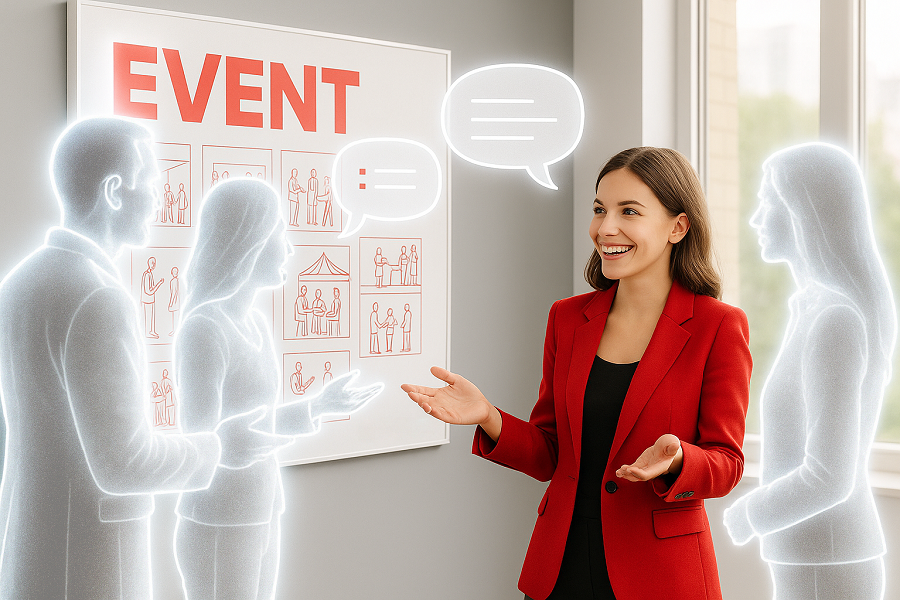
Putting them to work! Once programmed, you design the event with them, asking their opinion about the agenda, the formats, their willingness to discuss or participate, their expectations… And you co-design the event with these agents.
According to the agency, this allows for “precise alignment of content and touchpoints, resulting in more relevant, effective and impactful experiences for brands, businesses and communities.” Rather than relying solely on data collected after an event or through surveys, this approach integrates attendee feedback into the concept phase, as if attendees were involved in the design. “Post data becomes pre data,” and retrospective analysis becomes proactive design,” they say. They apply this method to projects and now publish an open book available here.