
Amsterdam brings museums out into the street to seduce visitors again
Share news
Listen

The “Catch me at the museum” campaign , promoted by Amsterdam&partners together with Monks and JCDecaux, is based on a very simple yet powerful idea: let the works of art themselves talk to people. Literally.
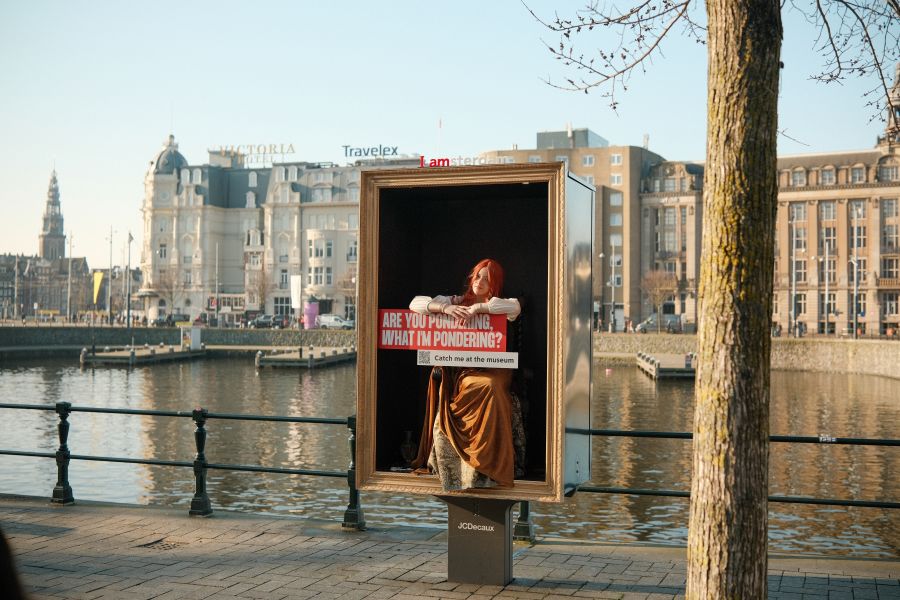
The creativities show works from ten museums in the city, such as Rijksmuseum, H’Art Museum or Foam, accompanied by bold, sarcastic and very current phrases that directly challenge the passerby. The message: the work speaks to you outside, but waits for you inside.
When outdoor advertising becomes an experience
The interesting thing about this campaign is not only the message, but how it has been taken to the experiential terrain. Because this is where outdoor advertising ceases to be a medium and becomes a stage.
One of the installations turns a mupi into a living statue. An actress embodies the protagonist of a work and reacts when people approach: you can take pictures, interact, be surprised. Suddenly, art stops being something you look at in silence and becomes something that looks at you.
The second installation plays with an old red telephone placed on a digital billboard. When someone passes in front of it, the phone rings. If you pick it up, you hear the character of a work of art talking to you and inviting you to visit the museum where it “lives”. It’s simple, almost theatrical, and that’s precisely why it works.
Museums no longer compete with each other, they compete with life.
This campaign is not just about advertising creativity or an eye-catching street action. It’s about how museums are redefining their strategy to stay relevant.
Today museums no longer compete only with other museums. They compete with restaurants, with stores, with festivals, with Netflix, with aimless strolling, with any plan that occupies a person’s time in a city. For this reason, culture has understood that it is no longer enough to program exhibitions: it must seduce, provoke curiosity, generate conversation and, above all, be part of the city experience.
And this is where something very interesting from a MICE and destination point of view comes in: culture as a tool to make a city more attractive, more balanced and more livable.
Amsterdam&partners explains it very well: the campaign does not seek to attract more visitors, it seeks that those who are already in the city discover its cultural offer. In other words, it’s not about quantity, it’s about distribution. It is about distributing the flows, diversifying the tourist experience, building a more sustainable city also through culture.
Destinations are no longer promoted, they are experienced
For years, destination marketing was based on showing places. Today it is based on provoking experiences. The difference is enormous.
You used to see a museum in a brochure. Now a work of art calls you on the phone in the middle of the street.
And that difference changes everything, because it turns promotion into experience. And when a city manages to make its culture part of what happens to you as you travel through it, that city stops being just a destination and becomes a story that you are living.
Amsterdam, with this campaign, is not only promoting museums. It is reminding people of something important: that culture is not an afterthought, it is part of the soul of the city. And that sometimes, to get people into a museum, you first have to get the museum out on the street.